
Here are the most frequently asked questions about LEI.
If you have any further questions, please do not hesitate to contact our helpdesk directly via lei@gs1belu.org or call +32 2 229 18 80.
LEI stands for Legal Entity Identifier and is used to identify companies that are active on financial markets. It is an alphanumeric code consisting of 20 signs and guaranteeing transparency and security amongst the various financial parties thus enabling traceability of the transactions. More information about the LEI on http://default.gs1belud8lei.web-002.gs1belu.prvw.eu/en/does-my-company-need-lei GLEIF website.
The issuance of a LEI is subject to strict regulations. Some organizations may issue LEIs, but must follow a GLEIF accreditation procedure. GS1 Germany was awarded this LOU (Local Operating Unit) status in February 2017. So we send them the application so that they can issue the LEI.
For companies who are trading in derivatives and who are requested to notify this activity in compliance with the EMIR (European Market Infrastructure Regulation) the LEI is mandatory since 12th February 2014.
Starting 3rd January 2018 the application area of the LEI will however largely expand in conformity with the new European MiFID II/MiFIR regulation (Art.26 of Regulation nr.600/2014).
As of the beginning of next year, European financial institutions must indeed notify their supervisor of all transactions carried out by their customers-legal entities involving specific financial instruments. For the Belgian banks this supervisor is the FSMA, the Authority for Financial Markets and Services.
As a result, Europe had developed new identification requirements. These apply to each legal entity active in trade of financial instruments being offered on a trading platform (or underlying products being exchanged on a platform), such as shares, bonds, warrants, state loans, warrants, state loans and state notes. This new measure does not apply to some investments, investment insurances, term deposits, deposits and savings certificates.
This compulsory identification applies to purchase and selling transactions (including beyond stock exchange), some specific transfers, voluntary corporate actions and donations.
What does this imply for you as a company ?
All legal entities wishing to purchase or sell one of the abovementioned financial instruments, is required to identify itself by an LEI. The legal entity is in charge of obtaining its own LEI.
Individuals and company departments without legal autonomy do not require an LEI.
Similar to an IBAN (International Bank Account Number) or a BIC (Business Identifier Code), the structure of the LEI code is based on an ISO standard (ISO 17442:2012)
The LEI format consists of 20 alphanumeric terms and adopts the following structure:
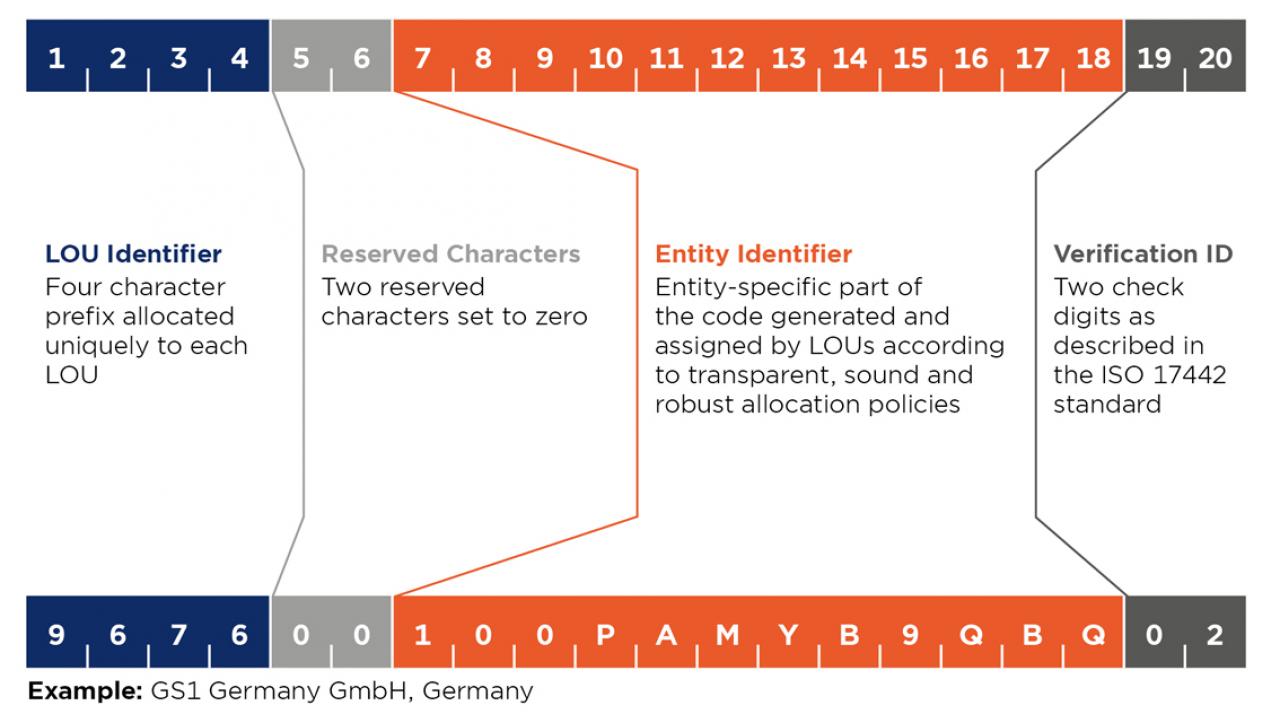
- Code: 1234 56 789101112131415161718 1920
- 1234: 4 character prefix coming from the LEI issuer. 9676 has been exclusively allocated to GS1 Germany as LOU (LOU = Local Operating Unit).
- 56: two separating characters, temporarily reserved positions.
- 789101112131415161718: twelve digit identification of the legal entity.
- 1920: two positions check digits as described in the ISO 17442 standard.
The issuing of an LEI is subject to strict regulations. Only organizations having successfully passed an accreditation process of the Global Legal Entity Identifier Foundation (GLEIF), are entitled to issue LEIs. These parties are called Local Operating Units (LOUs). GS1 AISBL obtained the status of LOU in February 2017. All requests are sent to them and they will assign the LEI.
Member of GS1 Belgium & Luxembourg?
Log in via My GS1. Under "order products" you select the option "LEI" and follow the instructions.
Your data will undergo a thorough verification. Upon approval, your LEI will be sent via e-mail.
Question? Contact us via lei@gs1belu.org or +32 2 229 18 80
Non-member of GS1 Belgium & Luxembourg?
Register first via My GS1 and afterwards, log in with your chosen username and password. Under "order products" you select the option "LEI" en follow the instructions.
Your data will undergo a thorough verification. Upon approval,your LEI will be sent via e-mail.
Question? Contact us via lei@gs1belu.org or +32 2 229 18 80
An LEI is valid for 1 year. You will receive an automatic renewal notification 6 weeks before its expiry date.
Member of GS1 Belgium & Luxembourg?
- Log in to My GS1
- Click "Transfer my LEI" and follow the instructions
The transfer is free. You have already paid for the current year; as of the following year, we will notify you of the extension of your LEI.
No member of GS1 Belgium & Luxembourg?
- Register on My GS1 and log in
- Click "Transfer my LEI" and follow the instructions
The transfer of an LEI is free. The current yearly fee is being paid, we will notify you for the renewal of your LEI starting the following year.
If the LEI has not yet been awarded, the application may be cancelled and the amount refunded. However, if the LEI has already been awarded, we can no longer do anything. A LEI is in fact linked to the company throughout its existence. The LEI will be valid for one year and will not have to be renewed thereafter.
In order to transmit the correct information about your company, you just have to look at the Crossroads Bank for Enterprises (CBE).
Here you will find all the information about your company: the correct name, VAT number, ...
When applying for LEI, you must provide an excerpt of the RSC.
In order to comply with the requirements of the GLEIF, we are obliged to monitor the relationship between your company and the parent company/ultimate parent company. Would you therefore be able to forward consolidated annual accounts of the parent company/ultimate parent company (this is often part of the annual report)? We would like to emphasize that it must be a consolidated proof.
If your (ultimate) parent does not have a consolidated annual account stating your company name, the GLEIF does not recognise the relationship between your organisations.
In that case, it is necessary to terminate the relationship in the application by removing the (ultimate) parent.